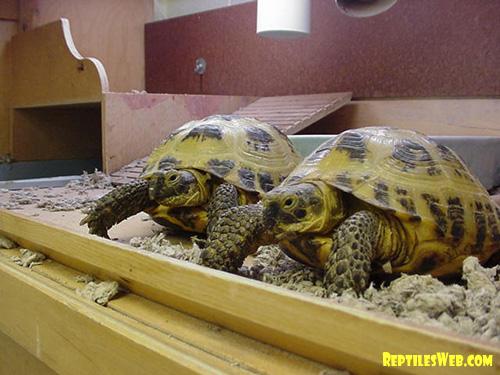
Russian Tortoise
For more picture, check Russian Tortoise Pictures
| | Scientific Name |
-
Agrionemys horsfieldii
- Formerly know as Testudo horsfieldii
| | Description: |
- It also has the generic name of Russian Tortoise, Central Asian Tortoise, Four-Toed Tortoise, Afghanistan Tortoise, Horsfield's Tortoise and Steppe Tortoise.
- Russian Tortoise or Afghanistan Tortoise is one of the most famous and popular tortoises in the world.
| | Distribution: |
- These tortoises are mostly found in middle east countries such as Uzbekistan, Afghanistan, Kazakhstan, Iran, and some area in North Western China.
- Naturally can be found near hillsides, rocky deserts, sandy or loamy steppes
| | Breeding: |
- Mating is actively done during the summer season (mid of March to mid of June, naturally)
| | Nesting: |
- 2 to 6 eggs per clutch
- Up to 3 clutches per season
- Incubation takes 80 to 110 days, at constant 30.5�C
- Hatchling happen in August or September in natural
- Russian babies are measured at around 32mm to 34mm in length
| | Size: |
- Up to 6 - 8 inches in size
| | Life Span: |
| | Diet: |
- High fiber, low protein and calcium rich food is necessary
- Russian Tortoise loves leaves, grasses, weesds, vegetables and flowers
- Since the tortoise hibernate during winter, and tends to eat a lots during summer, you'll find out that if you keep them indoor, it'll eat lots all year long
- This will create improper growth for the tortoise
- The recommedation is to feed them 30 minutes a day as how much they can eat, and stop feeding them
- Please be reminded that the food much be variety, do not feed them the same food everyday
- mix up hoya plants and green plants (Endive, Romaine lettuce... ) Different mixing preferably everyday
- Try not to feed them with fruits, grains or animala protein food
- Mxing the food with vitamin D3 power or calcium supplement is highly recommended
- A dish of water should be provided all time
| | Habitat: |
- This kind of tortoise prefers open dry lanscaping
- The tortoise is an expert burrow digger
- Naturally Russian Tortoise hibernate during winter or cold whether
- The active period of the time for this tortoise is from mid of March to mid of June (summer season)
- Estivation or aestivation do happen during the summer
- In summer, they forage.
- At temperature of 21�C to 31�C, the tortoise is found most active
- Hibernation is from October to March in Uzbekistan
- Dry and sparse bushes or grasses
| | Common Disease: |
- Inproper growth if diet is not controlled well
| | Vivarium Housing: |
- Prevent damp if you keep them outdoor
- Indoor housing must be large enough for their movement, at least 3 feet by 4 feet enclosure
- Temperature should be controlled with basking spot at around 31�C and a cooler spot with a hide box
|
|





