|
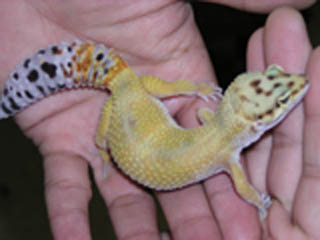
Leopard Gecko
For more pictures, click Leopard Gecko Pictures
| | Scientific Name: |
| | Description: |
- Leopard geckos are among the largest geckos. Most leopard geckos have a yellow background with brown spots covering the adults. Juvenile geckos have a predominantly striped pattern that fades to the spotted pattern with age.
- They also have a very obvious outer ear and differ from many geckos in that they have eyelids and lack adhesive lamellae, meaning they can't walk up vertical services.
| | Distribution: |
- Leopard geckos are found in Iran, Afghanistan, Pakistan, and India.
| | Breeding: |
- Leopard geckos are relatively easy to breed. One male will mate with several females so people tend to keep them in groups of one male to 3 or 4 females.
- Pregnant females can usually be detected because of a bump on each side of her abdomen. If provided with a laying box females will tend to use it. Something like a cool whip tub with a hole cut in the side that is filled with moist moss or vermiculite will provide an attractive place for the females.
- Females will usually produce multiple clutches of eggs during breeding season. The eggs should be removed from the egg laying box and incubated in vermiculite with a 1:1 ratio of water to vermiculite by weight.
- The plastic shoebox inside of a ten gallon aquarium makes an adequate incubator. If incubated at 85 degrees they should hatch in around 2 months.
- A higher incubation temperature will produce more females.
- The newborn geckos will not eat until after their first shed (usually after about a week). they can then be started on appropriately sized insects. It's also best to house them separate, such as in plastic shoeboxes.
-
Breeding normally begins around spring time when the air temperatures and day length increase. Seasons vary in start time and length from season to season depending on temperature levels, however, breeding normally commences anywhere from January to March and can carry on until September.
-
Male gecko are very persistent and will continually pester the female, this can obviously stress the female and be detrimental to her health, or could lead to the male or female being injured.
-
If you decide to keep your male and female(s) together, you should be very vigilant for problems (such as bullying, stress, injuries etc). In addition, if you are keeping a breeding group, you should also be aware that some of the females may not tolerate each other. The alternative is to keep your male and female(s) separate all year round, only introducing them for mating during the breeding season- this method has many advantages (you can be sure when they mated, monitor each of the geckos more closely and you also lessen the risk of injury/bullying). The female only needs to mate once to produce fertile eggs all season (they can store the sperm). | | Nesting: |
| | Size: |
| | Life Span: |
| | Diet: |
- Leopard geckos are relatively easy to feed because they will thrive on insects. A staple of crickets along with occasional waxworms and mealworms make a good diet.
- Adult geckos can also be fed an occasional pinkie mouse. Juveniles can be feed every day and adults every other day. Supplementation is a must for leopard geckos. Two supplements should be used: one that is just calcium/D3 and another that is a reptile multivitamin. Juveniles should be supplemented at every feeding and adults at every other feeding.
- A shallow water dish should be provided at all times and changed daily to stop bacteria and fungus growth. Allowing leopard geckos access to a moist area is a good idea that aids in shedding. Even though they come from arid climates their burrows tend to have moderate humidity. People can supply this humidity by moistening the area under their hide boxes. Make sure that the overall cage isn't wet or overly humid.
| | Habitat: |
- An aquarium is a perfect home although many people have success with plastic sweater boxes. Since they are a terrestrial species, a long aquarium is better than a high one. Make sure that you only have one male per enclosure as males will fight each other. Rocks and logs can make the terrarium more natural looking and they provide your lizards with places to climb and get exercise. A hide box is also recommended for each lizard for use in times or conflict and for sleeping.
- A shallow water dish should be provided at all times and changed daily to stop bacteria and fungus growth. Allowing leopard geckos access to a moist area is a good idea that aids in shedding. Even though they come from arid climates their burrows tend to have moderate humidity. People can supply this humidity by moistening the area under their hide boxes. Make sure that the overall cage isn't wet or overly humid.
|
|





