|
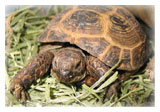
Also known as Horsfields Tortoises, these are among the most commonly seen tortoises in the pet trade today. Thousands of juveniles are exported from Russia every year. Russian tortoises are small, reaching approximately 15cm long or a maximum of 20cm. Being a Russian species, they make an excellent choice for UK pet keepers. They can tolerate the English weather and will hibernate over the winter period. The shell is a light olive brown colouration, with darker brown blotches. The head and legs are a lighter, yellowish brown.
Housing
It is recommended that for the first few years of your Russian tortoise life, you keep it indoors in a controlled environment. A perfect enclosure would be an open top, box style enclosure measuring L120cm x W60cm x H45cm. This box can be constructed from a number of materials, although melamine coated wood is preferable.
These tortoises need a dry substrate with the ability to dig. They are persistent diggers and like to build their own burrows to hide in. It is not essential to provide a deep substrate, but preferable. The choice of substrate really depends on you as a keeper, however you must bare in mind that it must be kept dry at all times. Horsfields tortoises do not tolerate damp surroundings and will slowly deteriorate if kept under these conditions. Sand, soil, mulch, fine gravel and Repti-turf are all good substrates for your tortoise.
Heating and lighting is vital for your tortoise to grow a healthy shell and live a long life. Russian tortoises are a diurnal species and therefore require UVA and UVB rays normally gained through the suns rays. A two in one heat / UV bulb is the best option and should sit no further than 12� higher than where the tortoise will bask. This heated area should reach approximately 90˚F, allowing the opposite end of the enclosure to drop to around 75˚F.
Decor is an important part of enriching your tortoise�s life. By placing some foliage, rocks, wood and other items in your enclosure, your tortoises mind will be more stimulated and it will allow for more exercise. Be careful not to place any objects in the enclosure where the tortoise could accidentally fall up-side down in an area where it could not turn itself upright again.
Many keepers choose not to place water into the enclosure. Rather, they bathe the tortoise every few days allowing for an adequate drinking and cleaning session. It does not matter too much whether you do this or not. However, water must be accessible to your tortoise at least twice a week. If you place a water bowl in your enclosure, it must be shallow and have easy access in and out of it. Be careful not allow spillage either, as damp surroundings is not tolerated well.
Feeding
Russian tortoises are generally very good feeders, and eat almost anything you could put in front of it. Many keepers will place a variety of foods into a shallow bowl and place it in the same spot every day. Try to stay away from this habit; it is important to stimulate the tortoise and make it work for its food. Spread the food out across the enclosure and offer different feeding methods. For instance, put a cabbage leaf higher up on the wall of the enclosure. This will force the tortoise to stretch its head upwards and pull chunks off the leaf.
Most fruit and vegetables can be fed with little problem. However, certain foods should be avoided. Such foods include iceberg lettuce and tomato. These have little nutrition and will often give your tortoise diarrhoea. Some of the best foods include: greens, romaine lettuce, kale, shredded carrots and kale. Fruits such as apple, banana, strawberries, blackberries and pears can also be fed, although should be limited. Specialist tortoise diets are an excellent addition to a tortoise keeper�s cupboard. They can be fed every day, although this is not stimulating for your tortoise and should only be fed sporadically between fresh food feedings.
Supplementing your foods with calcium and mineral dusting powders are vital, along with UV rays these will help ensure your tortoises shell and bones are kept strong and healthy. Reptavite dusting powder, specially formulated for tortoises is an ideal supplement.
By Chris Jones
Director of Pet Club UK Ltd.
http://www.petclubuk.com
Article Source: http://EzineArticles.com/?expert=Chris_M_Jones
Chris M Jones - EzineArticles Expert Author |